
I’m excited to finally write about Lettercamp, a product that I’ve been working on actively for the last few weeks, but something I’ve been thinking about in the back of my mind for many years.
Lettercamp is an open-source framework for creating a beautiful content site. Basically, it’s a blog in a box. Now it’s possible for anyone to spin up a full content site with all the key features built in:
- Homepage grid and post pages with optimized titles, descriptions, and layouts
- Full support for rich markdown features like links, tables, images, and more
- SEO optimized from the start, including 100 Lighthouse scores across the board
- Built-in pagination, search, categories, authors, and more.
Lettercamp is built on top of Astro, a popular content site framework, which means that it’s performant, but more importantly, it’s a static content site that doesn’t require a database lookup to serve content. This means that your content can fully live in your codebase and be directly accessible by your favorite AI agent.
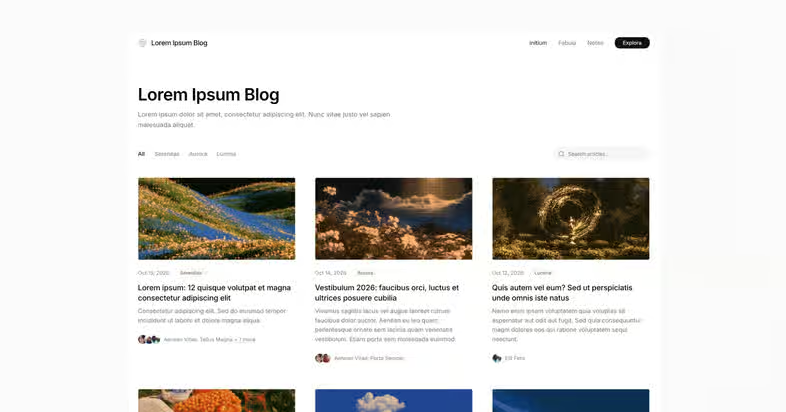
Lettercamp comes out of the box with a beautiful content site
In addition, Lettercamp is fully customizable and supports custom React components. So it should be easy to adjust the design and layout elements like the header and footer to better fit any brand.
I’m excited to put this out into the world! In this post I’ll share a bit more about the thinking behind the project, and why I think it’s an important product to be working on. If you’d rather skip to the code, check out the Github repo or the Lettercamp docs to get started.
Why Lettercamp?
Lettercamp is important because writing and publishing good content is a crucial part of the product development and launch process. In the last few years, I’ve learned firsthand the importance of good writing when it comes to building an audience, finding users, and growing a product.

Working on Lettercamp
While I was a co-founder at Kapwing, writing and publishing high quality content helped us grow the site from 0 to over 3 million monthly users in a matter of months. Content was so important to us that we actually created three deployments of content sites (Resources, Blog, and Help Center) so that we could publish different forms of content and create different articles that might appeal to different audiences.
For my work on one of my side projects, Mixfont, writing and creating high quality content on the Mixfont Blog helped me improve the SEO of the site and attract valuable coverage from publications like Forbes, Fast Company, and Smithsonian Magazine. This writing directly contributed to traffic to the site for core features like the font generator.
Clearly, publishing good content is important and startup founders need to think carefully from the start about how to incorporate that into their product launch process.
However, good writing isn’t as effective if it isn’t delivered through the right interface. In much of my previous work, I felt frustrated that engineering related issues were getting in the way of the thing that actually mattered: good content. There were so many little tasks that were in the way before I could actually just sit and down and write:
- Setting up a cms system so that publishing content was not dependent on a full code CI/CD progress
- Handling image and media uploads so that they were fast and performant across all the pages
- Implementing proper pagination and metadata so that pages were indexed correctly by search engines
- Supporting the rich components I wanted to include in my posts like tables, videos, code blocks, and more.
On top of all these, I also wanted to be able to use Codex and Claude Code to help draft and proofread my content without needing a complex integration or MCP server setup.
I started Lettercamp to solve all these problems for myself. I feel excited about this launch because I know that even if no one has this issue, I can still benefit from using Lettercamp for the Lettercamp blog and the Mixfont blog. They say to use your own product and that’s exactly what I’m doing for this launch. I hope that that might mean other developers and founders might have a similar frustration, and perhaps Lettercamp can be a solution for them as well.
How Lettercamp Works
Lettercamp gives teams a way to start writing and publishing content as quickly as possible, as a developer in 2026 would expect.

Lettercamp posts support authors, cover images, and rich text editing all out of the box
The open-source Lettercamp framework comes out of the blog with all the features you would expect from a modern blog setup. Each post is backed by MDX, which means it can be edited directly, but it also supports inline custom React components, which means that content can be interactive and extensible. When built, Lettercamp sites are completely static sites, which means that pages are server side rendered and don’t require additional database calls or remote fetches to properly render. The result is a performant, modern site that is compatible with any existing website.
A good engineer might argue that it’s possible to vibe code their own blog for their website pretty easily. That’s true, but from firsthand experience my rebuttal would be that it’s still a lot to vibe-code. There are many specific features to build for a high quality, SEO optimized blog site, and that time might be better spent working on the core product, instead of a a content site. Lettercamp is designed to be spun up in seconds, saving teams this work and time. But if you wanted to move to a custom implementation, there’s nothing stopping that - since all the content still lives within your own codebase.
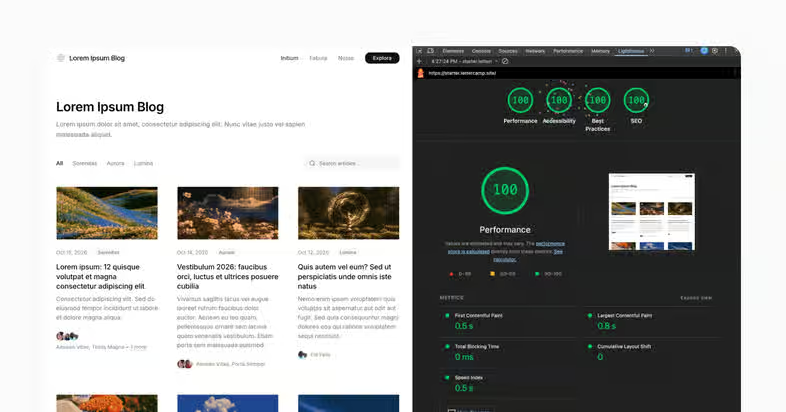
Lettercamp comes with 100 Lighthouse scores out of the box
Lettercamp Cloud
Lettercamp Cloud combines the open-source framework with a web-based editing interface that lets teams team write content without needing to interact with the code.
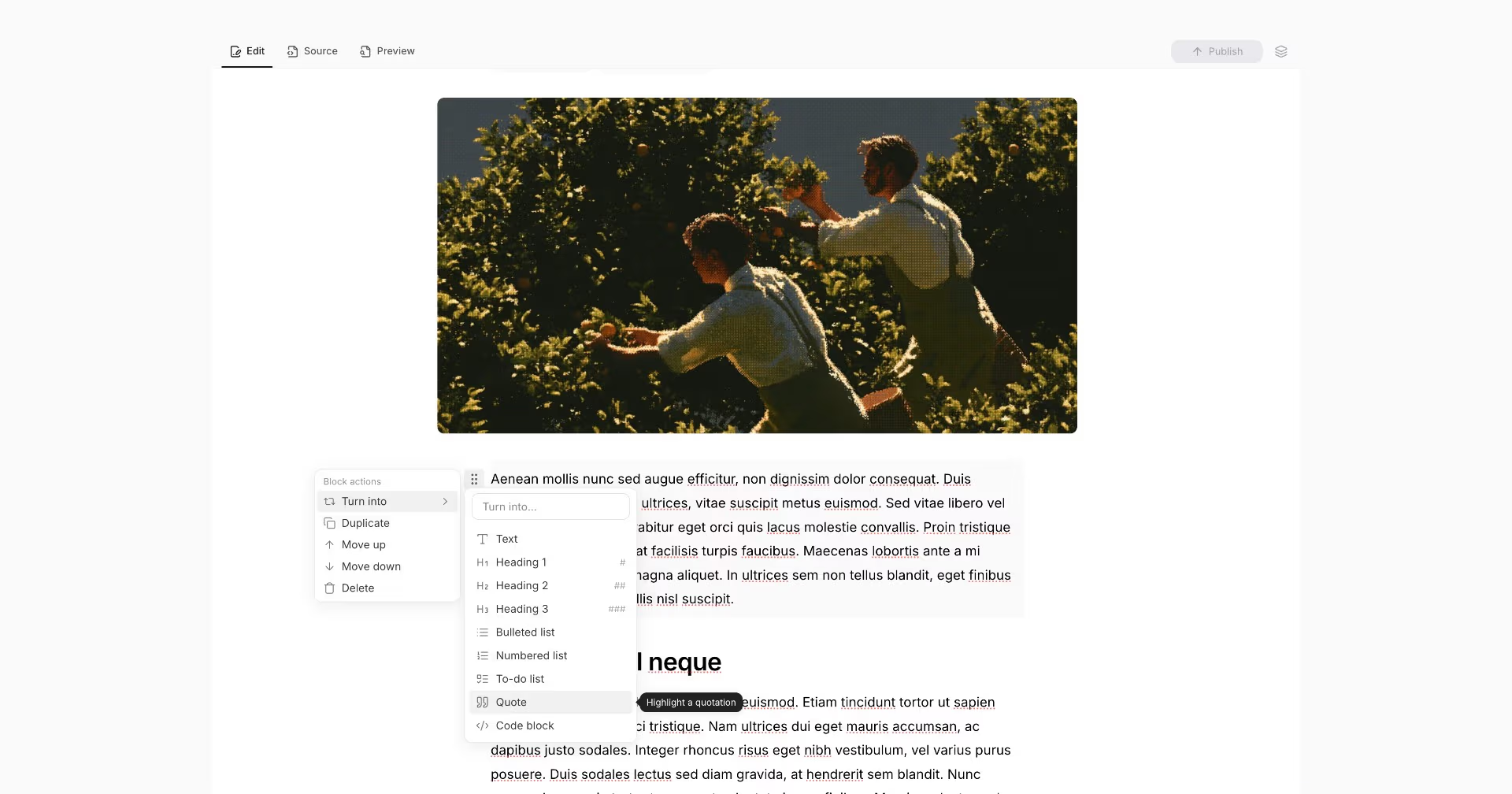
Lettercamp Cloud provides a Notion-like editing interface for blog content
The hope here is that content teams would pay for a online editing interface that decouples their content from the core product. This is the plan for making the maintenance and development of the open-source framework long term sustainable. The cloud version of Lettercamp also handles some of the basics of deploying a content site, like subfolder domain support, access controls, and image uploads and optimizations, and more.
Of course, creating and deploying a Lettercamp publication will never depend on paying for the cloud product.
What’s next
I’m excited to finally get to this point! While it’s an exciting launch, I feel like it’s only day 1 for this product. There’s so much farther to go in terms of optimizing content for search, agents, and readers all in one single platform framework. I also know there’s a lot for me to learn as a developer and maintainer of an open source product.
There is a long term vision for Lettercamp to become the self-writing and self-updating content platform for any product. That means that content could be put on auto-pilot, and content teams could react to news, trends, and developments in their space in real time. Readers would also be able to get more personalized content that is exactly tailored for their interests and needs. On top of this, the content should be accessible, localized, and performant.
There’s a lot more to build - but for now, I’m excited for this initial launch. Onwards!